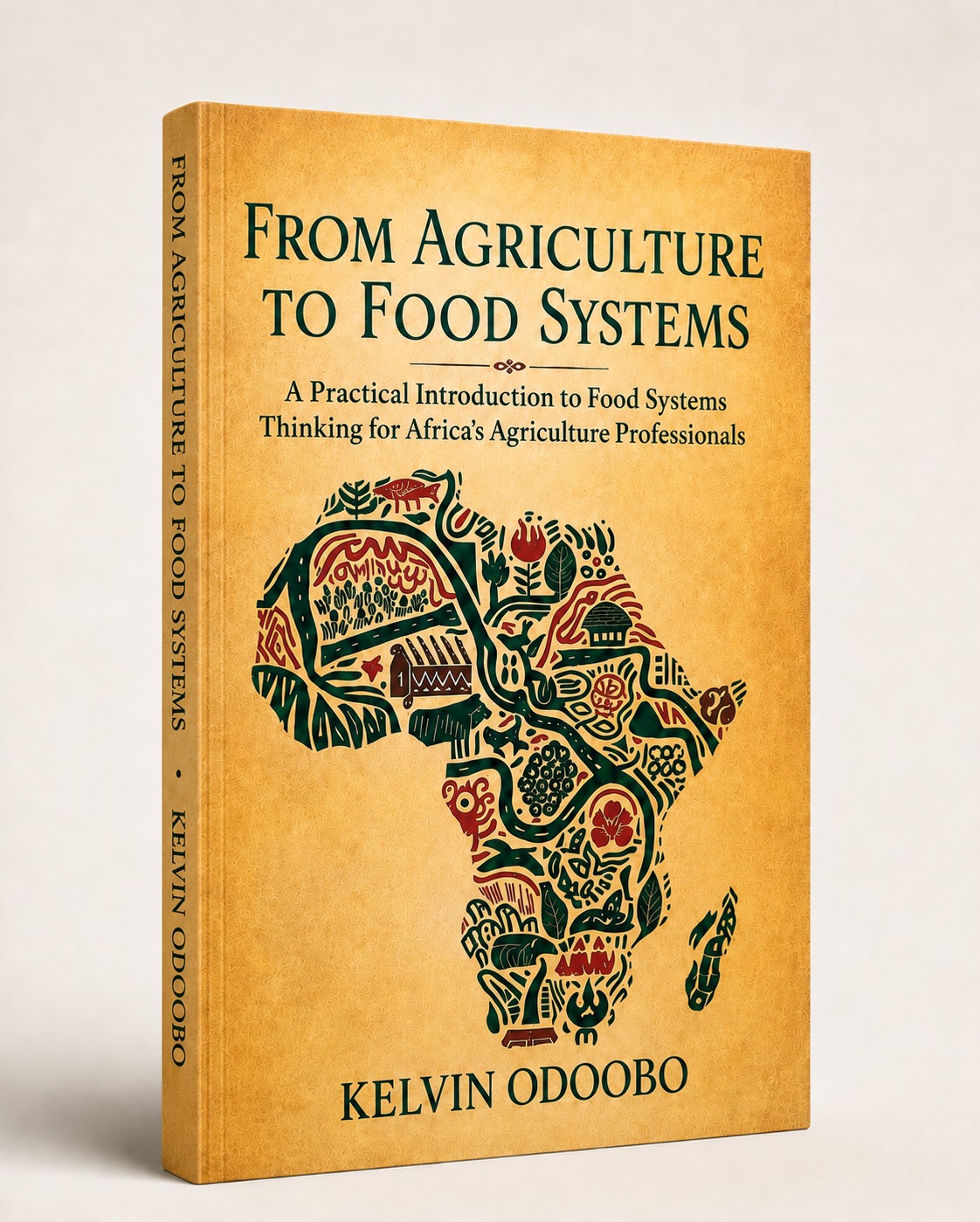
Across Africa, governments, development organizations and agribusinesses continue to invest in agricultural productivity, modern technologies and food security programmes. Yet for many smallholder farmers, increased production does not necessarily translate into higher incomes.
Why does agricultural progress so often fall short of delivering the economic transformation it promises?
In his book, From Agriculture to Food Systems: A Practical Introduction to Food Systems Thinking for Africa’s Agriculture Professionals, Kelvin Odoobo draws on more than two decades of experience across Africa’s agriculture and food systems landscape to explain this paradox.
His central argument is that many persistent agricultural challenges originate beyond the farm, in the markets, institutions, policies and relationships that determine whether increased production translates into economic prosperity
An accomplished agricultural practitioner, agritech founder, trainer and mentor, Odoobo has worked across public and private sector initiatives in several African countries, gaining experience in agribusiness development, agricultural technologies, institutional partnerships and food systems transformation.
The book’s contribution lies in translating food systems thinking into approaches that African agriculture professionals can apply in their work.
Why Producing More Is Not Enough
At the centre of the book is a framework called Nodes, Links and Power, which explains how food systems function.
Nodes represent actors such as farmers, traders, processors, financial institutions and government agencies. Links describe the movement of products, money, information and risks. Power determines who influences decisions, controls resources and bears losses.
In Chapter 2 example, he writes that farmers may increase milk production without achieving stable income growth because of seasonal demand fluctuations, inadequate cooling facilities, delayed payments and unequal bargaining relationships.
Another case, drawn from research around Mbarara in Uganda, highlights how milk contamination can increase at collection centres rather than on farms.
Both examples demonstrate why improvements in agricultural production cannot independently resolve problems elsewhere in the value chain.
What This Means for Rwanda
The book offers insights for Rwanda, where agricultural transformation remains central to national development priorities.
In Chapter 3, Odoobo examines the Fifth Strategic Plan for Agriculture Transformation (PSTA 5), the second National Strategy for Transformation (NST2) and the Rwanda Food Innovation Partnership approved by Cabinet in July 2026.
He recognizes Rwanda’s capacity to translate national priorities into programmes, institutional responsibilities and measurable performance expectations.
However, he distinguishes between policy direction and coordinated implementation.
Agricultural transformation depends on institutions responsible for production, trade, infrastructure, finance, environmental management and social protection. These institutions often operate under different mandates, budgets and performance indicators.
Consequently, an agricultural programme may achieve its production targets without resolving the commercial and institutional constraints affecting farmer incomes.
This raises an important question for African governments in their pursuit of food and nutrition security.
How can agricultural institutions move beyond individual programme achievements to shared outcomes, including farmer incomes, market performance and resilience?
Lessons From Across Africa
Odoobo draws on experiences from other African economies to demonstrate how policies, markets and institutions interact.
Kenya’s maize sector illustrates the challenges of coordinating input support, grain purchases, storage and imports. Ghana’s Planting for Food and Jobs Phase Two demonstrates efforts to connect agricultural inputs, financing, aggregation and markets.
Zambia’s transition towards electronic agricultural input vouchers offers another lesson: introducing digital technologies does not automatically resolve underlying institutional challenges.
Together, these examples reinforce the importance of coordination across food systems.

Understanding the Roots of Agricultural Challenges
The book also examines how colonial agricultural systems prioritized export commodities, production volumes and administrative control.
Odoobo argues that elements of this production-oriented approach continue to shape institutional mandates, policies and performance indicators.
He also recognizes that agricultural reforms are political as well as technical, shaped by competing interests, institutional incentives, and unequal power relationships.
Tools for Better Decisions
Beyond its analysis, the book introduces exercises to help professionals apply food systems thinking.
These include food systems mapping in Chapter 2, diagnosing institutional silos in Chapter 3, and assessing structural readiness in Chapter 5.
Extension officers can examine how technical recommendations interact with market realities. Programme managers and investors can assess conditions before committing resources, while policymakers and entrepreneurs can investigate institutional and commercial constraints.
The tools encourage professionals to connect their technical expertise to wider economic outcomes.
A Working Companion for Professionals
The book’s strength lies in making complex food systems concepts accessible to professionals across agricultural disciplines.
At more than 300 pages, it may not appeal to readers seeking a brief introduction to agriculture. For agricultural professionals, policymakers, researchers, and agribusiness leaders, however, its depth is likely an advantage.
Rather than a book to finish in one sitting, it is best approached as a working reference, something to revisit when designing programmes, evaluating investments, diagnosing institutional challenges or making strategic decisions.
Its value lies not only in what professionals learn, but in what they can apply over time.
Rethinking Agricultural Success
The book concludes by encouraging professionals to become system stewards.
System stewards are individuals who retain their technical expertise while taking greater responsibility for wider outcomes.For African countries pursuing agricultural transformation, the message is timely.
Productivity growth remains essential, but higher output alone cannot guarantee stronger farmer incomes, competitive agribusinesses or resilient food systems.
Perhaps the book’s most useful question is also its simplest:
When production improves, but livelihoods do not, what is happening elsewhere in the system?
Author: Kelvin Odoobo ( https://www.kelvinodoobo.com/ )
Formats: Kindle and paperback
Availability: Amazon and paperback copies in Kigali, Nairobi, and Kampala https://www.amazon.com/Agriculture-Food-Systems-Introduction-Professionals/dp/B0HD9N76JF/