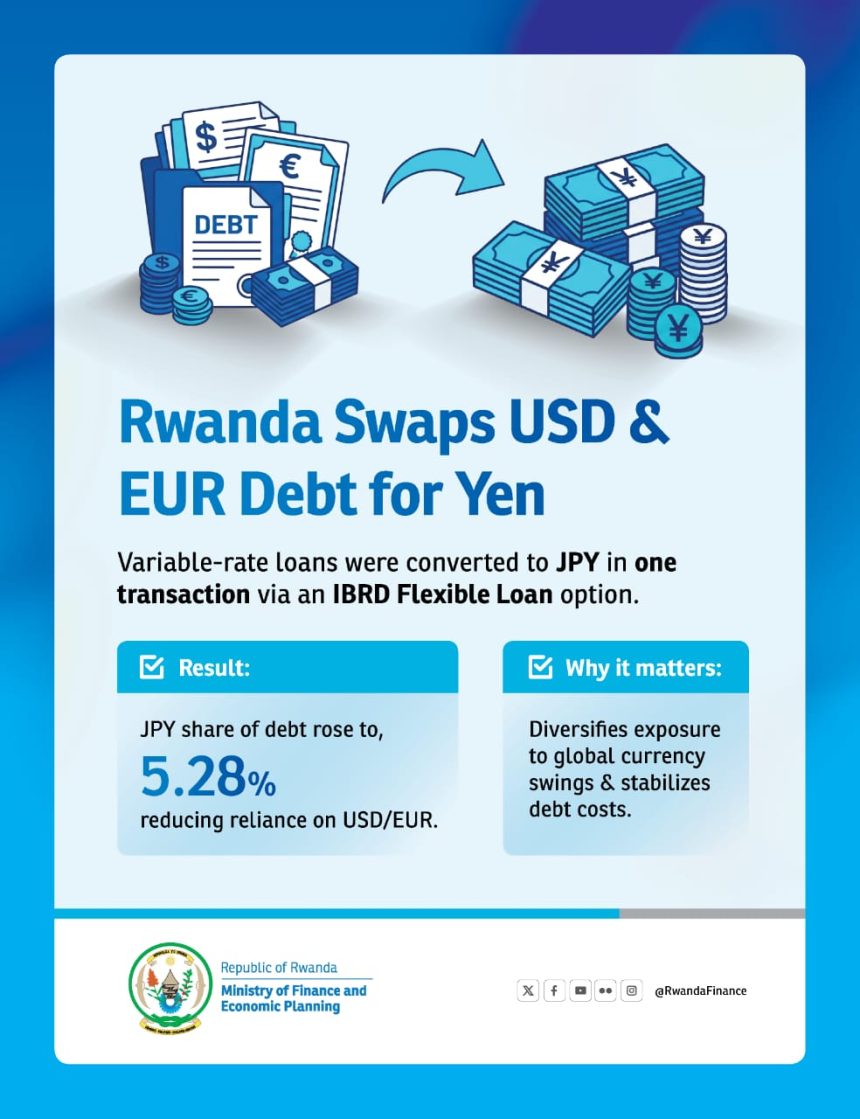
The Ministry of Finance and Economic Planning (MINECOFIN) has converted two World Bank loans worth USD 126 million and EUR 68 million into Japanese yen, as Rwanda strengthens its efforts to manage foreign exchange risks and stabilize debt repayment costs.
The move shifts part of Rwanda’s foreign debt exposure away from the US dollar and euro while diversifying the currencies it uses to repay external debt. both loans carry variable interest rates, which means repayment costs can fluctuate with market movements.
Why Rwanda chose the Japanese yen
Rwanda’s decision reflects the Rwandan franc’s performance against major international currencies over the past five years. During that period, the franc depreciated by an average of 8.0% annually against the US dollar and 7.2% against the euro, compared with just 1.2% against the Japanese yen.
The smaller depreciation against the yen offers Rwanda an opportunity to reduce its exposure to currency fluctuations and improve the predictability of debt repayment costs. By converting the loans into yen, the government diversifies its foreign debt currency mix and reduces its reliance on the dollar and euro.
The Japanese yen now accounts for 5.28% of Rwanda’s foreign debt currency composition, reflecting the government’s efforts to broaden its debt management strategy.
MINECOFIN uses existing loan options
MINECOFIN carried out the conversion through an option already included in the original World Bank loan agreements, so the government did not need to negotiate new loan agreements.
The move follows Rwanda’s first interest-rate swap earlier in 2026. During that transaction, the government converted a variable interest rate on a euro-denominated loan into a fixed rate, protecting the budget against potential increases in global interest rates.
While the earlier swap targeted interest-rate risk, the latest conversion addresses foreign exchange exposure. Together, the two transactions show how Rwanda uses financial instruments to manage borrowing risks and protect public finances from external market volatility.
Rwanda strengthens its debt risk management strategy
Rwanda’s proactive approach to financial risk management reflects years of investment in analytical capacity and institutional development. These efforts enable the government to identify financial vulnerabilities and take action to manage them.
By adjusting loan conditions and diversifying currency exposure, Rwanda is taking a more active role in managing public debt. The strategy could improve the predictability of future repayment obligations and strengthen the country’s resilience to international financial market fluctuations.
The latest conversion highlights Rwanda’s continued efforts to manage its debt portfolio strategically as global financial conditions evolve.